
Problem of Errors in Prime Editing
Prime editing is an advanced genome editing technique that replaces targeted DNA sequences with programmed ones without creating double-strand breaks. However, this process generates undesired indel errors (insertions-deletions) that can have harmful effects.
These errors occur when the edited 3′ DNA strands have to displace competing 5′ strands to install changes. A bias toward retaining the competing 5′ strands limits efficiency and can cause indel errors.
Discovery of Cut Relaxation Mechanism
Researchers discovered that certain Cas9-nickase mutations relax the nick positioning, destabilizing the competing 5′ strands and promoting their degradation. This key finding revealed the mechanism underlying editing errors.
They screened 14 Cas9 mutations and identified six variants (R780A, K810A, K848A, K855A, R976A, H982A) that increased 5′ end degradation frequency up to 22-fold while reducing indel errors up to 20-fold.
Next-Generation Prime Editor Architectures
Precise Prime Editor (pPE)
The K848A-H982A variant named pPE reduced errors 36-fold compared to the standard PE, improving the edit:indel ratio to 28-fold. However, pPE showed slightly reduced editing efficiency.
Extra-Precise Prime Editor (xPE)
To restore efficiency, activating mutations (R221K, N1317R) were added, creating the xPE variant with an edit:indel ratio reaching 354:1.
Very-Precise Prime Editor (vPE)
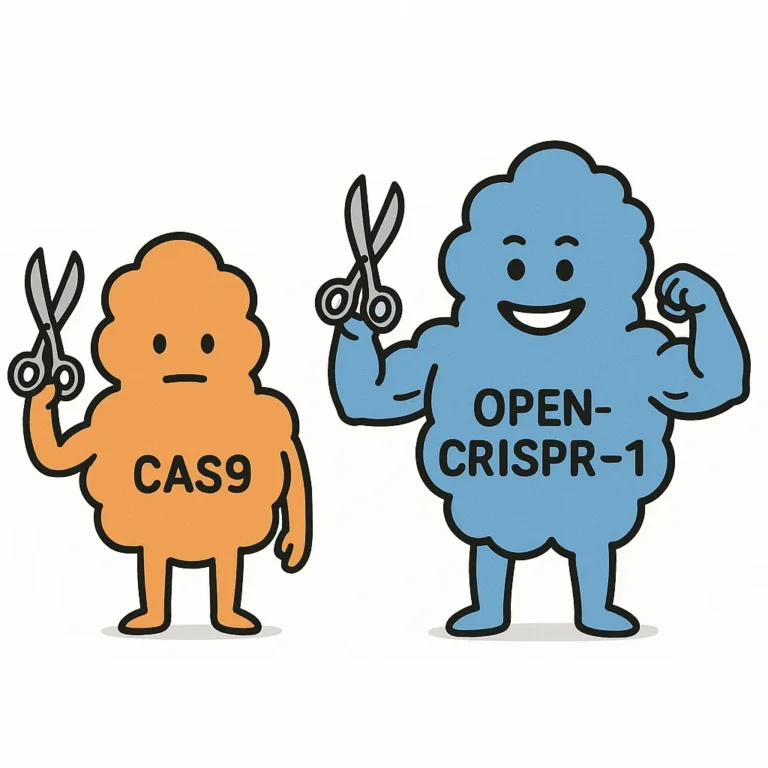
The final vPE version combines the optimized Cas9-nickase of xPE with the PE7 architecture including the La RNA-binding protein that stabilizes pegRNA. This innovation represents the study’s major breakthrough.
Exceptional vPE System Performance
Results showed dramatic improvements:
pegRNA + ngRNA mode: 8.5-fold error reduction with ratio up to 102:1
Maintained efficiency: average 32% editing vs 34% for PE7
vPE transforms the error rate from one in seven edits to one in 101 in standard mode and from one in 122 to one in 543 in high-precision mode.
Multi-Cell Validation and Applications
vPE was tested on several cell types including HEK293T, A549, HeLa, and murine embryonic stem cells. In stem cells, vPE reached 15% editing efficiency with almost no errors, compared to 9.3% editing and 2.8% errors for PE7.
Off-target editing assays showed vPE reduces non-specific edits up to 14-fold compared to PE7, likely due to mutations suppressing off-target cuts.
Molecular Mechanism and Innovations
The key to success lies in nick positioning relaxation that favors degradation of competing DNA ends. This discovery reveals a new paradigm: modulating substrate DNA stability to improve editing and suppress errors.
Incorporating the La protein stabilizes the 3′ ends of pegRNAs, especially important when overlap between pegRNA and 3′ DNA ends is reduced.
Therapeutic Impact and Future Outlook
This breakthrough could revolutionize gene therapy by eliminating a major constraint of prime editing. The approach does not complicate delivery systems and requires no extra steps while producing much safer edits.
“For any medicine, you want something effective with minimal side effects,” says Robert Langer. “For diseases requiring genome editing, this could ultimately be a safer and better way”.
The team is now working to improve prime editor efficiency further and develop tissue-specific delivery methods, still key challenges in gene therapy.
Conclusion
The vPE editor is a major advancement that could transform prime editing’s clinical application. By reducing errors up to 60-fold while maintaining high efficiency, this innovation paves the way for safer gene therapies for hundreds of genetic diseases.
📖 To read in the Nature article: Chauhan, V.P., Sharp, P.A. & Langer, R. Engineered prime editors with minimal genomic errors. Nature (2025). https://doi.org/10.1038/s41586-025-09537-3